Just a quick update: base-coat and pre-shading done on my IS-3. I will add more color modulation and highlights, but it is starting to look like something.
Yeah!
While I was pre-shading and basecoating my IS-3 tank this weekend (a post coming about that soon), I decided to pre-shade and basecoat an old model I had lying around: a Sturmpanzer IV “Brummbar” from Tamiya (a model almost 30 years old!).
Of course models made in the 80’s had fewer details than those made today. I could spend countless hours trying to improve my Brummbar and make it close to today’s standards (I was tempted to do so for a while, of course…). But in the end, I just decided to keep it like that, “out-of-the-box assembly” and concentrate on the paint job, weathering, and diorama.
I’m not a big fan of the camo pattern I used, but it seems appropriate for the time and location (Italy!).
I’m planning to use some foliage and branches to hide the most annoying details.
I’m pleased with the result so far.
My new tank project: a 1/35 soviet IS-3 heavy tank from Tamiya.
It is a nice kit, quite easy to put together. But it is an “old” kit (released in 1998, or something like that) and as such, it offer fewer details and options than more recent kits. And the kit has vinyl tracks :-(. So I had to do some detailing work, added some wires, handles made from strips of thin metal, plasticard bits, etc. I’m not 100% done, but quite close.
Overall, it is a tank with an impressive look, even more so when you consider that it was developed near the end of WWII (1944). It seems it was not used in combats in WWII, but it was part of the victory parade in Berlin on September 7 1945.
More to come; stay tuned.
Увидимся! (see you!)
Yeah! I’m finally done with my Hetzer Diorama. Like all dioramas projects, there’s still a few little details that bug me, but overall I’m pleased with the diorama. And I can move on to other stuff. My workbench is full of unfinished pieces just waiting some loving care…
Meanwhile, enjoy the pictures:
Wow! I’ve been away from this blog for a while: sorry folks! But I am back, and I will start posting cool stuff again!
Beginning with this update on my Hetzer diorama. I’m almost done with the ground work!
I’ll be ready to apply some pigments as soon as the glue will be completely set. So this diorama is close to be finished! It took quite a lot of time to do the detailing on the terrain (vegetation) but in the end, I am pleased with the result.
In case anyone is wondering, I used Oregano to simulate dead leaves. The smell of spices mixed with white glue is a bit weird, but the effect is quite cool. I did a couple of washes (different shades of brown) to give some depth to the soil and blend it better with leaves and twigs.
Cool! More posts coming very soon!
Quick update: I’ve completed the basic ground work and base coated the soil. I added more debris, made a few small touch-ups and started the vegetation work. I plan to have a lot of high grass around the tank. On the opposite part of the diorama (facing the ruined house) it’ll be mostly dirt and some abandoned stuff (barrels, ammunition boxes, jerrycans, etc).
Adding all that grass is tedious, but the final result will hopefully be worth it.
As for the colours, don’t worry if you think they are still a bit too contrasted: I’ll wait until pretty much everything will be in place and then use pigments and washes. Some light spraying with the airbrush might also be useful to simulate a subtle coat of dust on the whole diorama. I’ll do some tests beforehand of course, but I think it will be good.
Enjoy the pics!
I worked a bit on my Hetzer diorama this weekend. I started by making more debris to use on the house ruin.
Individual bricks
First, I prepared some individual brick using strips of thin cork. These were held to a masking tape band, then airbrushed a warm shade of brown. I later dry-brushed them a bit with 2 shades of red. Then I used a warm pale grey sparingly just to simulate a bit of mortar on the bricks. I didn’t go over the top with blending and weathering, because once these will be glued on the diorama, they will have a wash of earth brown and brick-red pigments all over them.
Concrete
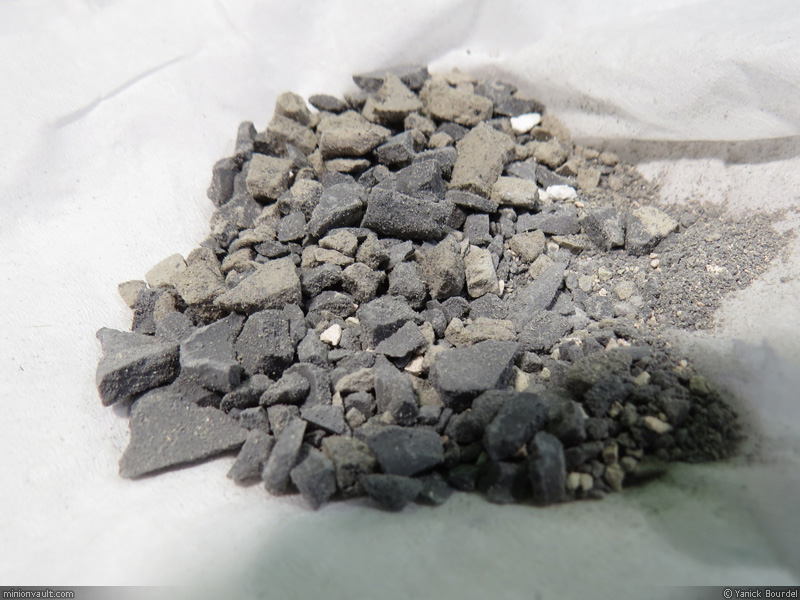
I prepared 2 small mixes of plaster in 2 different cups. In the first one, I added a mix of black and brown acrylic paints so the plaster will become a warm grey when dried. In the second one, I added only black; that batch turned cool dark grey. Each mix was poured in a soft plastic “tray” in a thin layer (about 5 mm). Once the whole thing was dried, I crushed the 2 batches so to obtain various sizes of “concrete looking” chunks and fragments. I mixed in some crushed cat litter (to simulate plaster fragments and add a bit of variety to the whole mix).
Bricks chunks
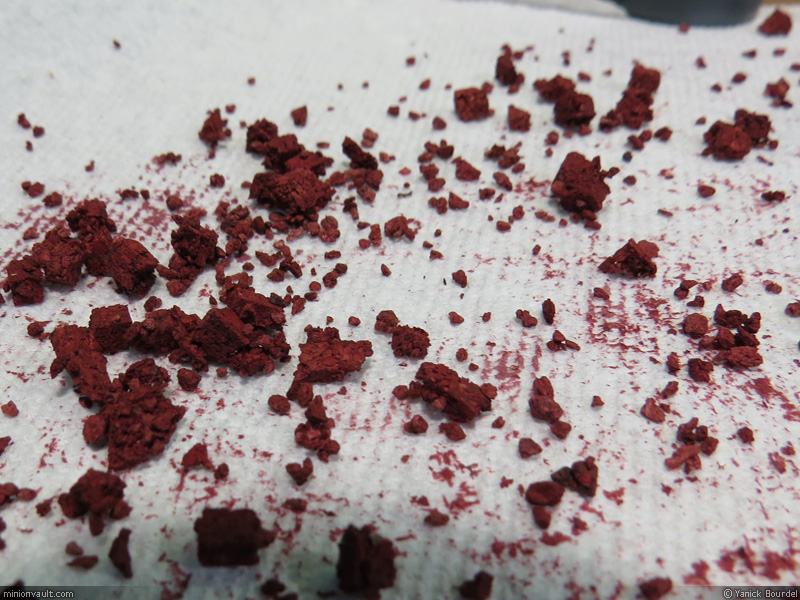
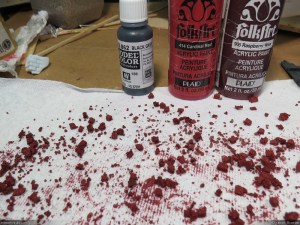
I took some strips of thin cork and cut it in pieces smaller than whole bricks, to simulate broken bricks. This was mixed with talus (little rocks used by railroad modellers) in a cup. I added brick-red acrylic paint, then mixed everything. The trick is to use enough paint so every bits in the mix will get covered, but not too much. If there is too much paint, the little fragments will stick too much one to another and it will be much harder to use later on. Before the paint was dried, I spread the mix on a paper tower, gently “rolling” the pieces on the towel with my fingers so the excess paint was absorbed by the towel.
Roof / floor “chunks”
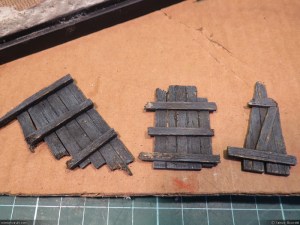
When a building collapses, it does not go down with all the material used in its construction now broken in individual pieces. Many bits of material remain “connected” or joined, with nails, cement, concrete etc. It is especially true for the roof and floors. So it is normal to find large chunks of material still bound together among the rubbles. I used some balsa wood to put together 3 “chunks” like that, all broken and weathered.
…And so it began!
With all this done, I was ready to start.
First, I used paint (dry-brushing) to give the ground some colours, in case a small area remains visible through the rubbles. Nothing fancy here: earth tones and some brick-red.
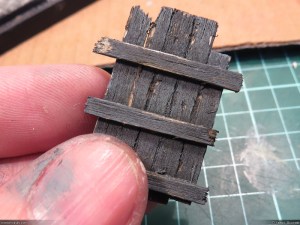
Second, I detailed the back of the building (especially the floor and what’s underneath). The wooden structure of the floor is mostly balsa, but I used popsicle sticks for the floor and plasticard sheets for the mouldings.
Then I started carefully laying down various bits of debris (bricks, planks, concrete, plaster, rusty pipe etc).
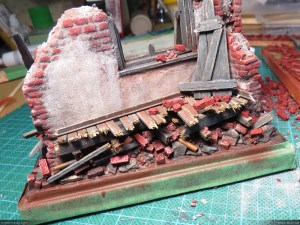
Everything is glued with white glue, and in case you’re wondering: Yes, every bit at this stage is placed individually, one by one. Tedious, but I want more control.
Third, I started the same process in the front of the building. So far, so good.
It still need more debris: Collapsed buildings produce an unbelievable amount of debris.
Don’t worry if you think the colours are a bit too contrasted and are lacking some “unity”: when all the debris will be in place, a good wash and pigments will help tie everything together.
Hope it inspires someone.

Not much this time. Just a quick update to show the progress on my Hetzer diorama. Enjoy the pics (and the comments)!
Simple test for my Hetzer diorama. The tank will be in ambush position behind a crumbled village house.
A good use for scrap models from my scratch building bin (mainly a motorcycle and a badly damaged 75mm german artillery gun).
Of course, it will need a lot of care (and painting) to make it look decent…
More coming soon.