Weathering almost done. I just have to add a touch of pigments & dust. Some minor details too (painting periscope lenses, tail light, adding machineguns on the sides of the turret).
Enjoy the pics!


Weathering almost done. I just have to add a touch of pigments & dust. Some minor details too (painting periscope lenses, tail light, adding machineguns on the sides of the turret).
Enjoy the pics!
I painted my E-100 tank. No weathering yet, just base colors, camo and decals.
I used Tamiya Dark Yellow as the base color, with highlights of a mix of Dark Yellow, White and Buff. The green is from Model Master 4798 Panzer Olivgrün 1943, It is a blueish medium green I find particularly good looking on Dark Yellow.
The tracks were simply painted black then added touches of Red Brown from Tamiya.
The red primer on the guns, on exposed parts of the sides and one of the skirts is Vallejo 70.985 Hull Red.
The skirts are not glued on yet (they were just applied temporarily to the tank with blue tack for the photos).
The fun will begin soon: weathering!!! Yeah!!!
Stay tuned!


Hi folks!
I want to show the monster tank I am currently working on: The german E-100.
This tank never saw actual combat and was only found as a partly assembled hull and plans. Nevertheless, it was supposed to be equipped with the Maus turret, wich was built (a prototype in fact), so we have a good idea of the overall look of the E-100.
The model I assembled is from Dragon. I was disappointed by the lack of details (no tools, inaccurate front side plates, no hooks for spare tracks etc. So I decided to improve the kit with some scratch built details.
I am almost ready to base coat this enormous beast. Enjoy the pics for now!


I needed some wooden crates to put on my 1/35 dioramas. After looking at various commercial products, I decided to try to make my own, and cast them.
I used various pieces of styrene to scratch build a few crates (the red one is a carved Lego brick, with bits of styrene added). The rope handles were made with small “strings” of epoxy putty (Magic Sculpt).
Once I was happy with the crates, I glued them on a thick sheet of styrene and used Lego blocks to form the “walls” of the mold.
Smooth-on products were used for the casting: Rebound 25 for the mold itself and Smooth-Cast 300 resin for the pieces.
Apart from the fact that a few air bubbles left some small holes on the surfaces (I later used some epoxy putty to correct that), I am quite happy with the result.
And now I can make as many crates as I need! Great!


Ok, so my E-50 is 99% completed, with dusting and all.
So it is time to begin the diorama. Yeah!
Take a look at the process: you will find comments on most pictures detailing the techniques and materials used.
Enjoy! Part 2 coming soon…


The chipping, oil filters and washes are completed on my E-50 Standardpanzer. I also made some mud for the tracks and wheels.
I still have to:
Not done yet…
I think I’ll start with the Rum 🙂


I have been working recently on a very nice E-50 Standardpanzer tank from Trumpeter. The model was easy to build (not too many parts) and is nicely detailed. The only problem is I got it on discount because the box had been opened and the barrel, gun mantle and fixation was missing. I ordered an aluminum barrel on E-Bay, and I scratch builded the mantle and gun fixation.
Since this is a so-called “paper tank” that was never built and never saw actual service, this is a “what if” project. This gives me a lot of freedom, for the camouflage, accessories and diorama.
As for the camo, I decided to go with a polka-dot hard edge ambush pattern. I used a paler shade of dunkelgelb because I wanted more contrast than usual. For the brown, I used Tamiya Hull Red XF-9 as in late war camouflage, the rust proof primer was often lay bare and used as brown in camouflage patterns. The green is Tamiya J.A. Green XF-13.
I tried using the airbrush to paint the dots (with a mask) but it was really tedious. It was also very difficult to be precise on many areas, so I finally decided to hand-paint the dots.
I’m planning to put this beast on a diorama full of debris, a “what if” version of Berlin in 1946, if the war turned out differently than it did…


Here it is! A dirty Soviet Steel Monster on a muddy and snowy Russian field.
I took more photos than usual to get a good view of the snow/mud effects, which I enjoyed making. I am quite pleased with the results.
Enjoy the pics!


Sorry everyone: I didn’t take photos of the painting an weathering steps of my ISU-152 diorama. This is just the final result.
The painting of the base began with a few dry-brushing of dark blue grey, up to a light brown-grey.
I then used various pigments, with alcohol as a temporary fixer. When I was satisfied with the pigments, I dabbed matt varnish onto the base using a soft brush. Once dry, I used the airbrush to slightly darken an lighten some areas.
With various diluted shades of blue grey and greenish grey, I went over some individual rocks to break the monotony of the cobblestone pavement. I then dropped some twigs, hemp rope fibres and small rocks, to dirty up the road.
The manhole cover, the drain grid and the tram rails were given a brown coat, followed by rust and pale dust pigments with a final metallic highlight (dry-bushing with gun-metal acrylic).
For the newspapers, I searched the web to find real examples of WWII german newspapers and printed them to scale on my laser printer. I soaked them in diluted white glue and apply them to the base. When they were dry, I used an earth coloured wash to make them look dirty and old.
I then spayed 3 generous coats of matt varnish on the whole diorama with the airbrush to seal everything and bind the pigments.
The tramway post is from Mini-Art and the wires are scratch builded from thin metallic wire.
The Nazi flag was made from Magic-sculpt and carefully painted. I think it adds a nice touch of color to the diorama and goes really well with the red star on the tank.
Finally, I added tiny dead leaves (dried Oregano…) to the base and the tank.
Enjoy the pics!


While waiting for my order of Krycell snow to arrive, I started to work on another diorama. This one, for my ISU-152. I decided to document pretty much every steps while doing it, so enjoy the step by step making of this diorama, part 1.
1- The base itself: A simple, and used, bevelled wooden base I had lying around would do the trick here. I had to scrape off some glue and old basing material from the surface with a chisel, then I used a hammer to fix a metal plate in the center, as a support for the bolt that will hold my tank in place.
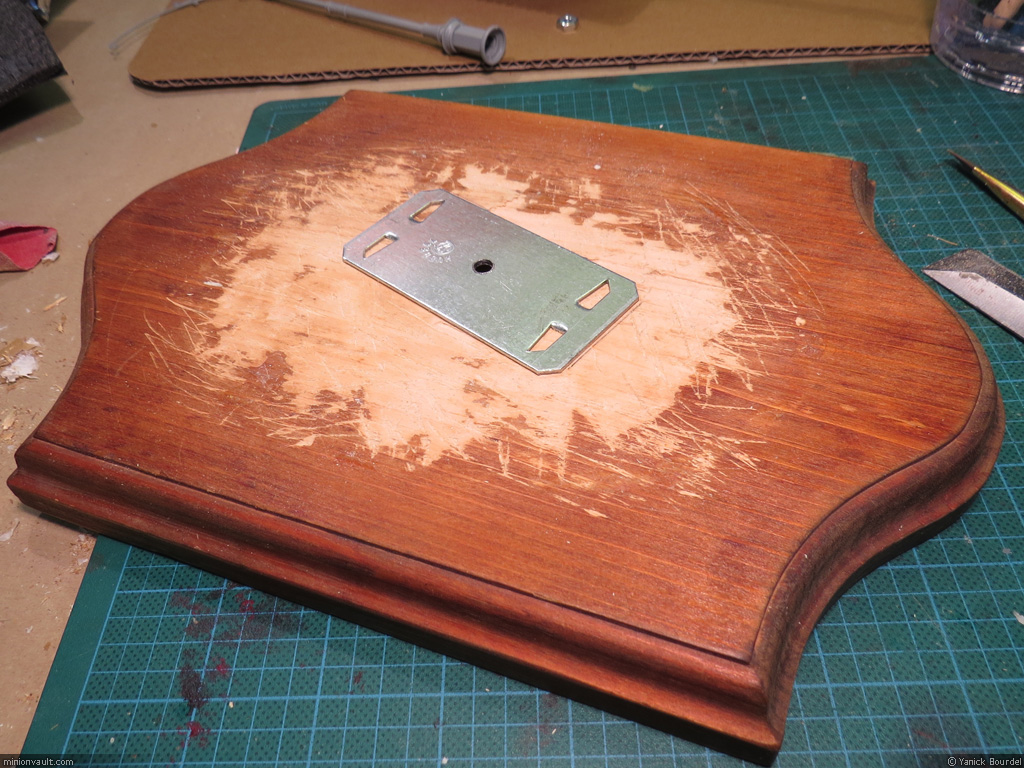
2- I made sure to drill a large hole in the base before, so it will be easy to turn the nut on the screw under the tank.


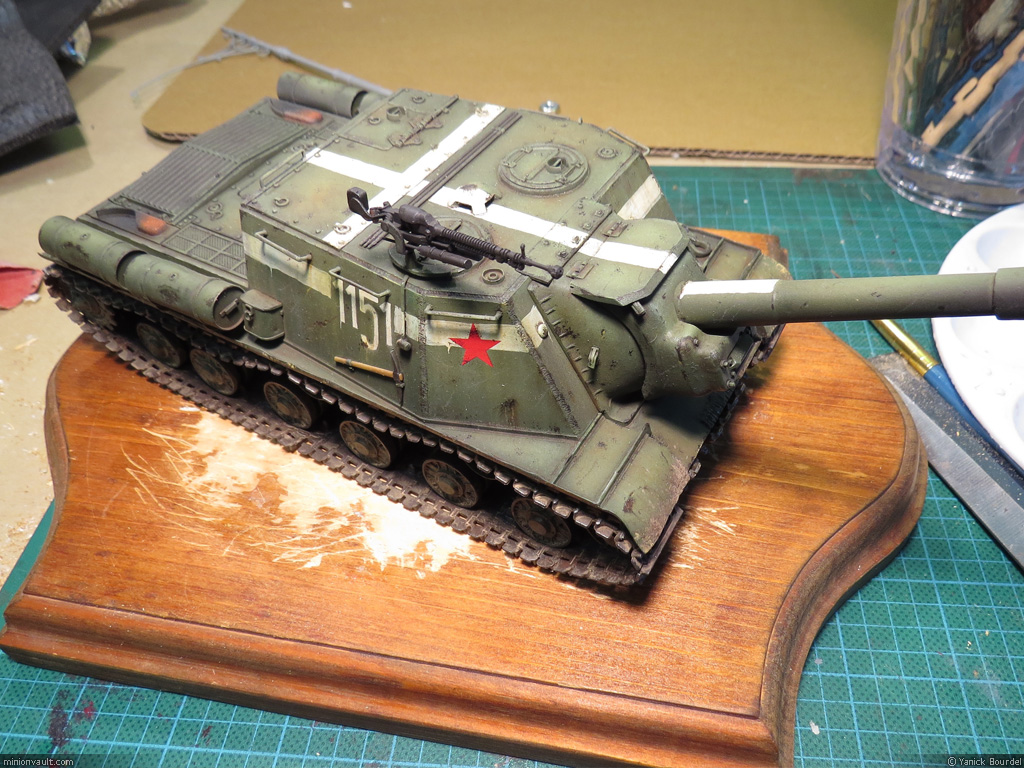
3- Foam core is a nice material to “carve” stone work. I used tracing paper to reproduce the exact shape of the wooden base, then used an X-Acto knife to cut it. I carefully peeled one side of the black cardboard from the foam core. Then I made another shape that I glued on top of the first one: this will become the sidewalk.


4- Using the X-Acto knife and a metal ruler, I carved 2 channels for the Tramway rails.
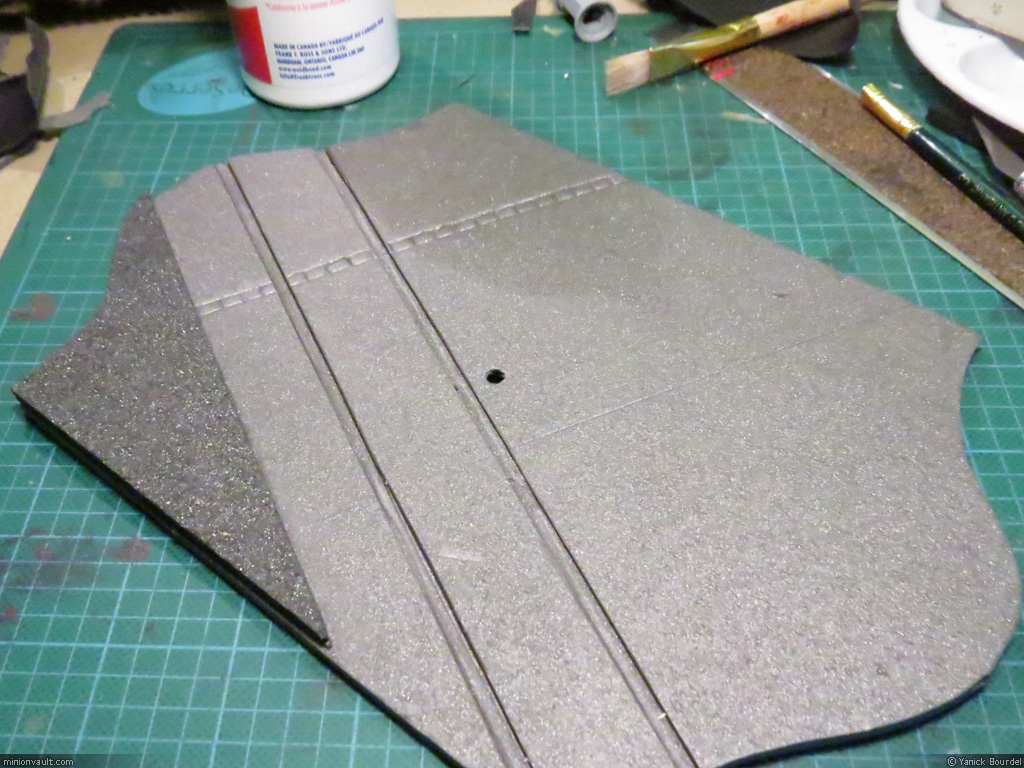
5- Then… the LONG work: using a custom-made tool (a modified old brush) I began stamping every stone of the pavement. Tedious. But the final effect was worth it, I think.

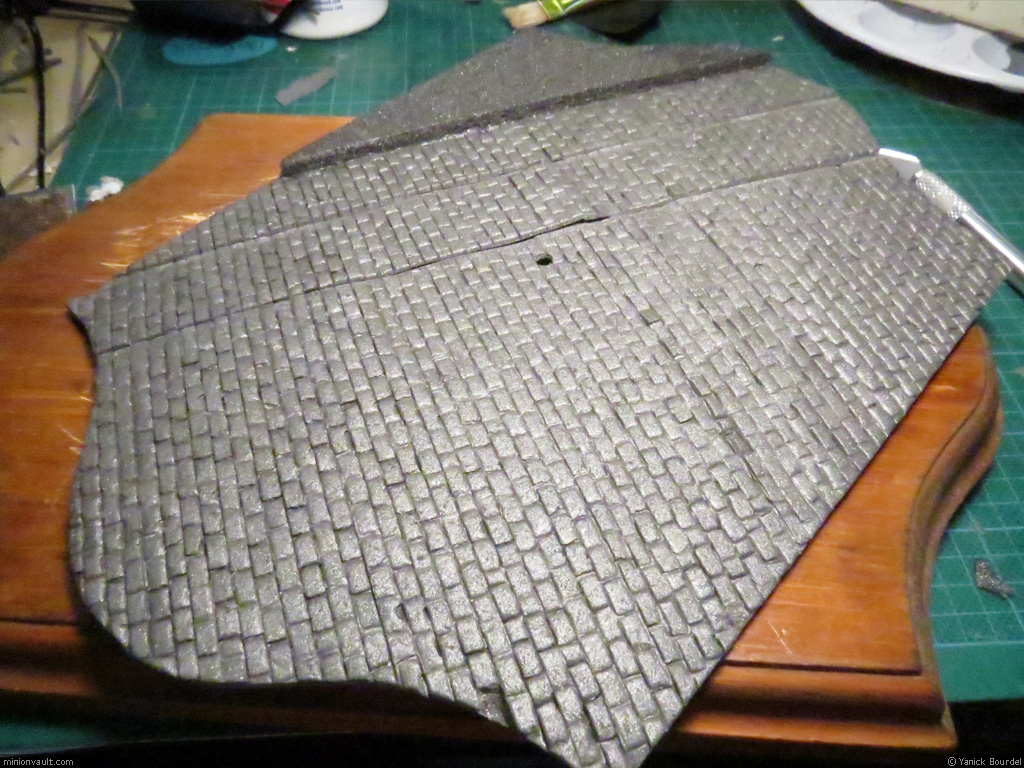
6- I did some carving on the sidewalk and used a small plastic bit to represent a drain cover plate.

7- I scratch builded a sewer manhole too, with left over bits and plasticard.

8- To make the Tramway rails, I glued strips of plasticard in a ” T ” shape. To glue them to the base was a challenge though: white glue won’t glue plastic very well, plastic glue would likely melt the foam core, and the hot glue gun was quite scary to bring close to my delicate foam carving… So I tried to use Tamiya putty, thinking it should bond quite well to both metal and foam. I did a test, but on a scrap piece of a DIFFERENT type of foam… B-I-G MISTAKE!!! It looked fine on the test piece, with very limited melting of the foam. But on my diorama, the Tamiya putty solvent (Acetone I presume now) melted huge patches of pavement… ARGH…..
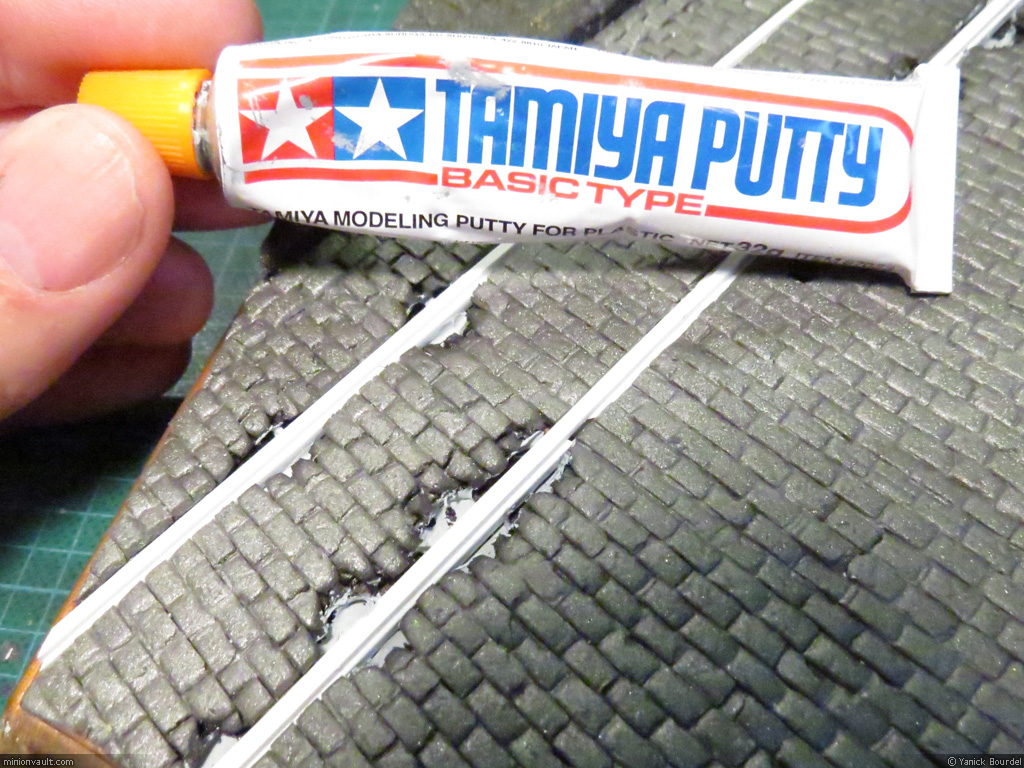
9- So I had to be meticulous and repair individual stones…

10- In the end, the final result is decent and once weathered It will look pretty much the way I wanted. Yeah!


Part 2 of this step by step guide coming soon…
 MINIONVAULT